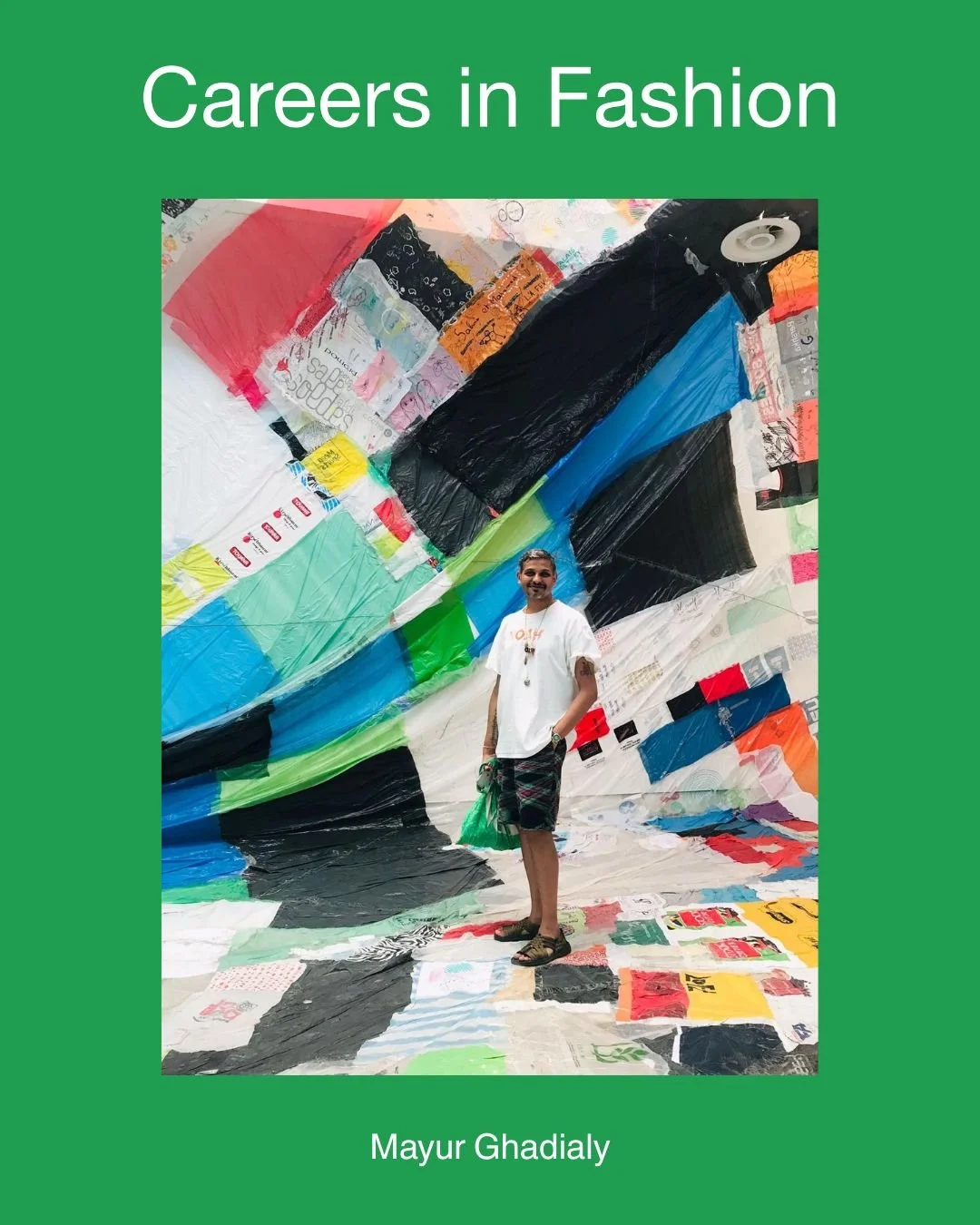
Mayur Ghadialy
Career: Fashion Design
Location: Milan
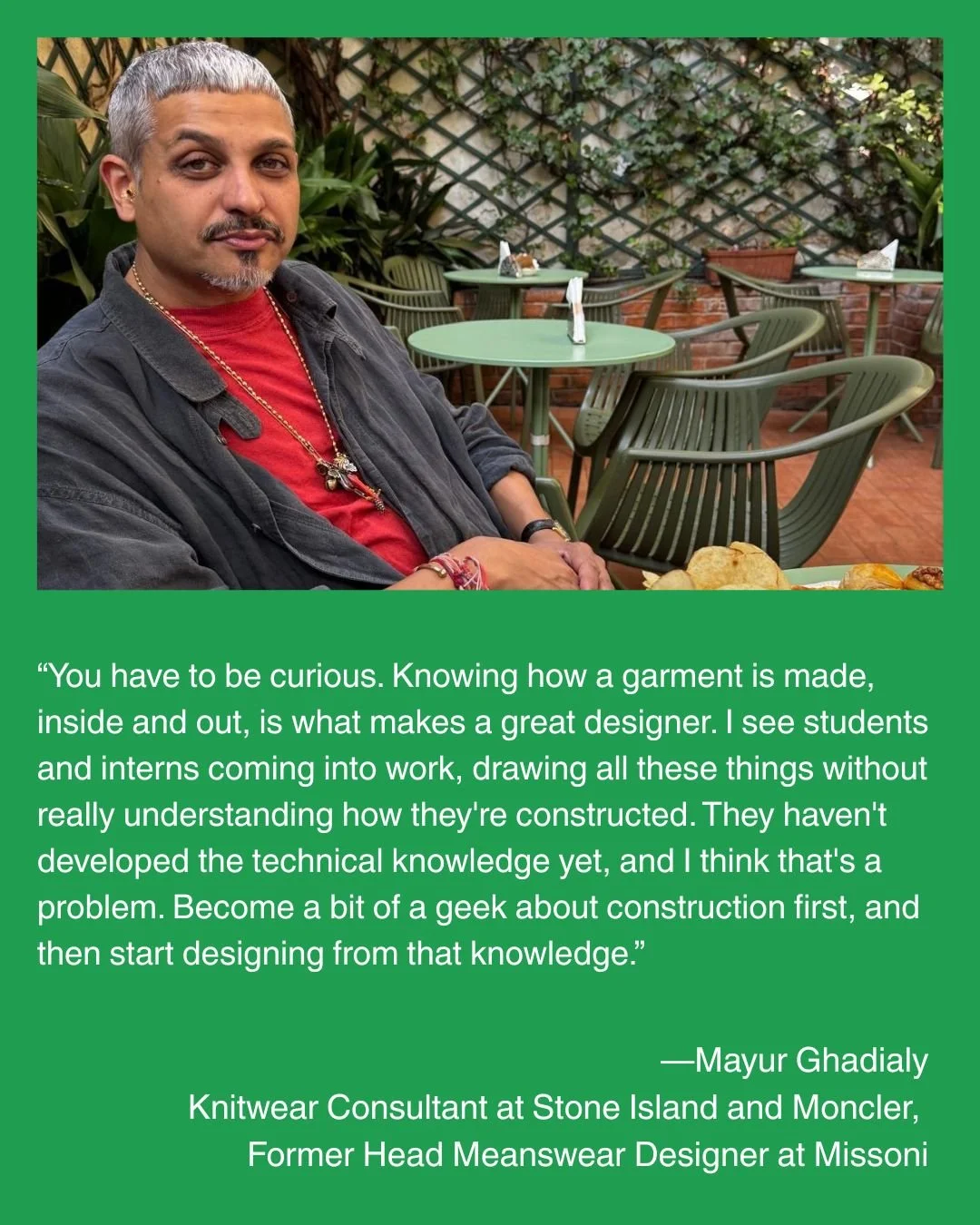
After studying at Ravensbourne University and the Royal College of Art, Mayur Ghadialy began his design career at Burberry. In 2008, he joined Missoni as a junior knitwear designer, before being appointed Head Menswear Designer at the historic luxury fashion house in 2012. Today, Mayur works as a knitwear consultant for Stone Island and Moncler.
He sat down with Careers in Fashion to share his candid insights and advice on building a successful career in fashion design.
What advice do you have for people who want to start a career in fashion design, but have little to no experience?
You have to be curious. Understanding the product is essential. Knowing how a garment is made, inside and out, is what makes a great designer.
I see students and interns coming into work, drawing all these things without really understanding how they're constructed. They haven't developed the technical knowledge yet, and I think that's a problem. You need to understand the details. Turn a garment inside out and look at how it's made. How is it constructed? How is it linked? Are the buttons mother-of-pearl? How are the buttonholes made? How is the collar put together?
That's what makes a good designer. Become a bit of a geek about construction first, and then start designing from that knowledge.
That's a great point. I think some people approach fashion design from a more aesthetic level, as if it's styling rather than construction.
Exactly. If you don't understand how something is constructed and you're interested only in the visual side, then design might not be the right career for you. You might be better suited to styling, fashion communication, or something similar.
What advice do you have for people with a few years of experience in fashion design who want to take their career to the next level?
Sleep with the right person lol.
LOL 😂
I eventually became a senior designer, and I was quite lucky. At Missoni, for example, I stayed for a long time and gradually worked my way up.
But what often happens is that you spend three or four years at one company as a junior designer, then move somewhere else and become a menswear designer. You stay for a couple of years and then move again, each time stepping up a level. That's a common career trajectory: Each time you make a jump, you progress.
Do you think you have to leave a company to move up or can you grow within the same organization?
Every company is different. I was fortunate at Missoni because they recognized my progress and gave me opportunities to develop. It depends on the company's culture and how it's structured.
But there's another consideration. If you stay at the same company and move from junior to senior designer, you may end up earning less than someone who leaves and takes a senior role elsewhere. If you move companies and negotiate for a more senior position, you're often able to command a higher salary.
What advice do you have for people who have been working in the industry for 15+ years? How have you navigated career growth and career longevity in the fashion industry?
You need to become a good leader. If you've been in a company for a long time, you probably have a team working under you, and you need to know how to manage those people well.
You have to make the most of the people around you rather than being afraid to ask for help. For example, I'm not particularly computer-savvy, so I rely on my team for certain things. I'm very technically knowledgeable when it comes to garment construction, but if I need help with something on a computer or with AI, I'll ask the people around me.
You need to be a team leader and recognize that other people have skills you might not have. And you have to give them credit, too. I have two junior designers who help me with Photoshop, AI, and things like that. I rely on their expertise, and I make sure they get the credit they deserve.
There’s a lot of people, at every career stage, facing a difficult job market right now. What advice do you have for anyone navigating unemployment?
When I left Missoni, I moved on quite quickly, and then I got a call from Palm Angels. But what I did during my spare time was work on a personal project. I wanted to have something I could show people and say, "This is what I've been working on." It demonstrated that I hadn't simply been sitting around doing nothing.
I know things are really difficult at the moment. The industry is going through a terrible period. I'd also encourage people to look beyond the biggest luxury brands. Everyone wants to work for Gucci, Prada, and the other major names, but consider mid-tier brands and independent labels, too. Even if the pay isn't as good, getting the experience and keeping your career moving can be worthwhile.
Take a look at a group like Kering. As I understand it, the business has been under significant financial pressure, and that affects hiring. When a group is struggling, it can put recruitment freezes in place or cut jobs. It's a difficult situation. So rather than focusing exclusively on the biggest companies, consider smaller businesses where there may be opportunities to contribute and develop your skills. Moncler and Loewe seem to be doing relatively well, but other parts of the industry are really suffering.
Let's talk about your time as Head Menswear Designer at Missoni. How did you get the job and what was your experience there like?
I got to Missoni because I'd already completed a project with them while studying at the Royal College of Art. I started as a junior knitwear designer. Missoni had separate design offices for menswear and womenswear, as well as a dedicated knitwear office. That knitwear office was almost like a kitchen of ideas. People were constantly producing swatches, and whenever the menswear or womenswear designers needed something, they'd come in, look through the samples, and choose what interested them. The knitwear team would then develop those ideas further.
Rather than spending every day just producing swatches, I ended up working more closely with the menswear team. The menswear designer saw what I could do and suggested that I join his office so we could work together. From there, I became a junior menswear designer and started developing the collections.
That was from 2008 to 2012. In 2012, Missoni appointed a new freelance menswear designer. He lasted about one season. His approach was to buy vintage clothes and have us reinterpret them in a Missoni style, then add our knitwear to complement the collection. Angela Missoni eventually said, in effect, "I'm paying someone a lot of money to bring me vintage garments to copy. Why don't we let you do it instead?"
My first collection as menswear designer was Spring/Summer 2013. That's really where it all began.
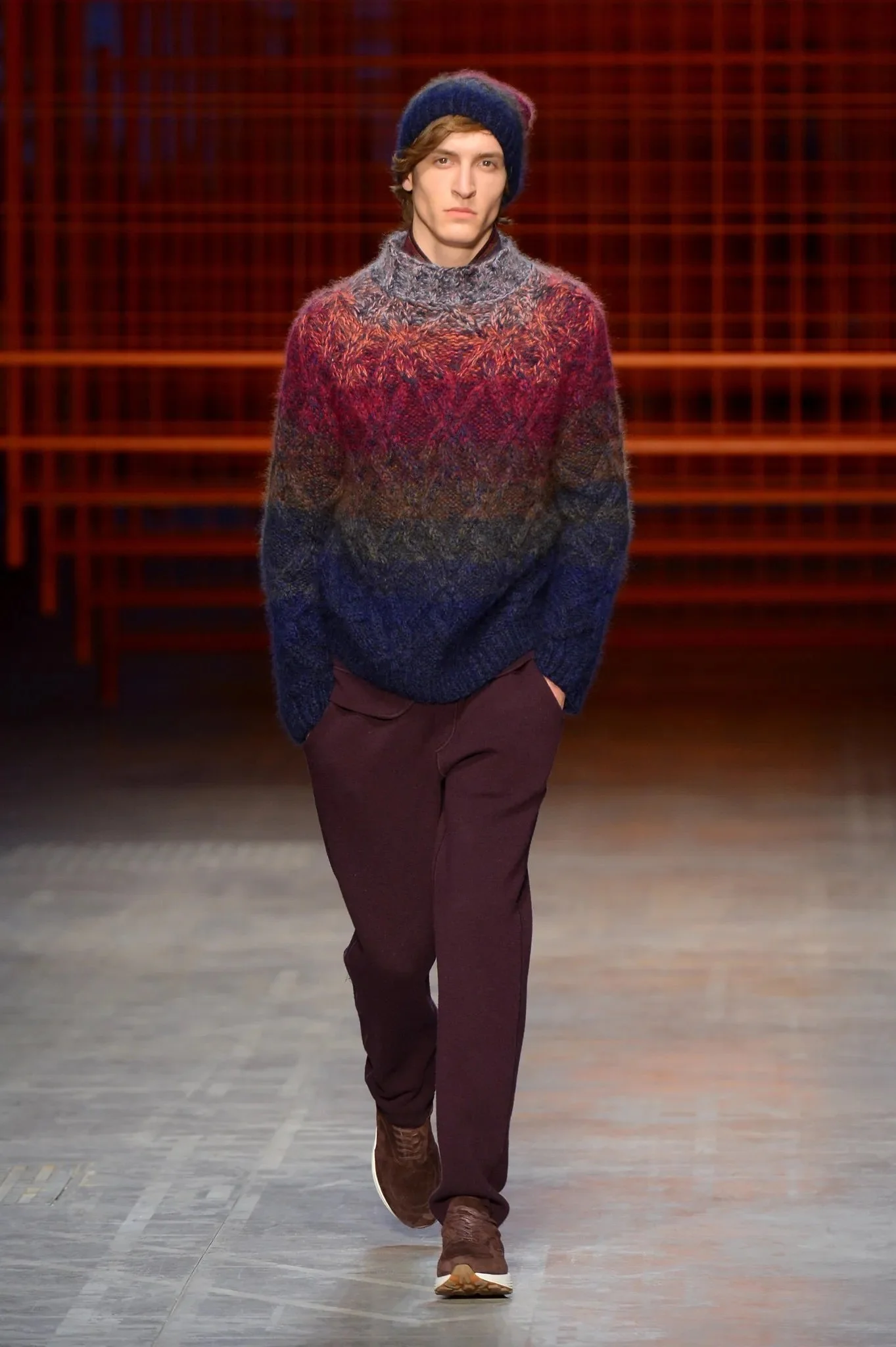
Missoni Fall/Winter 2017
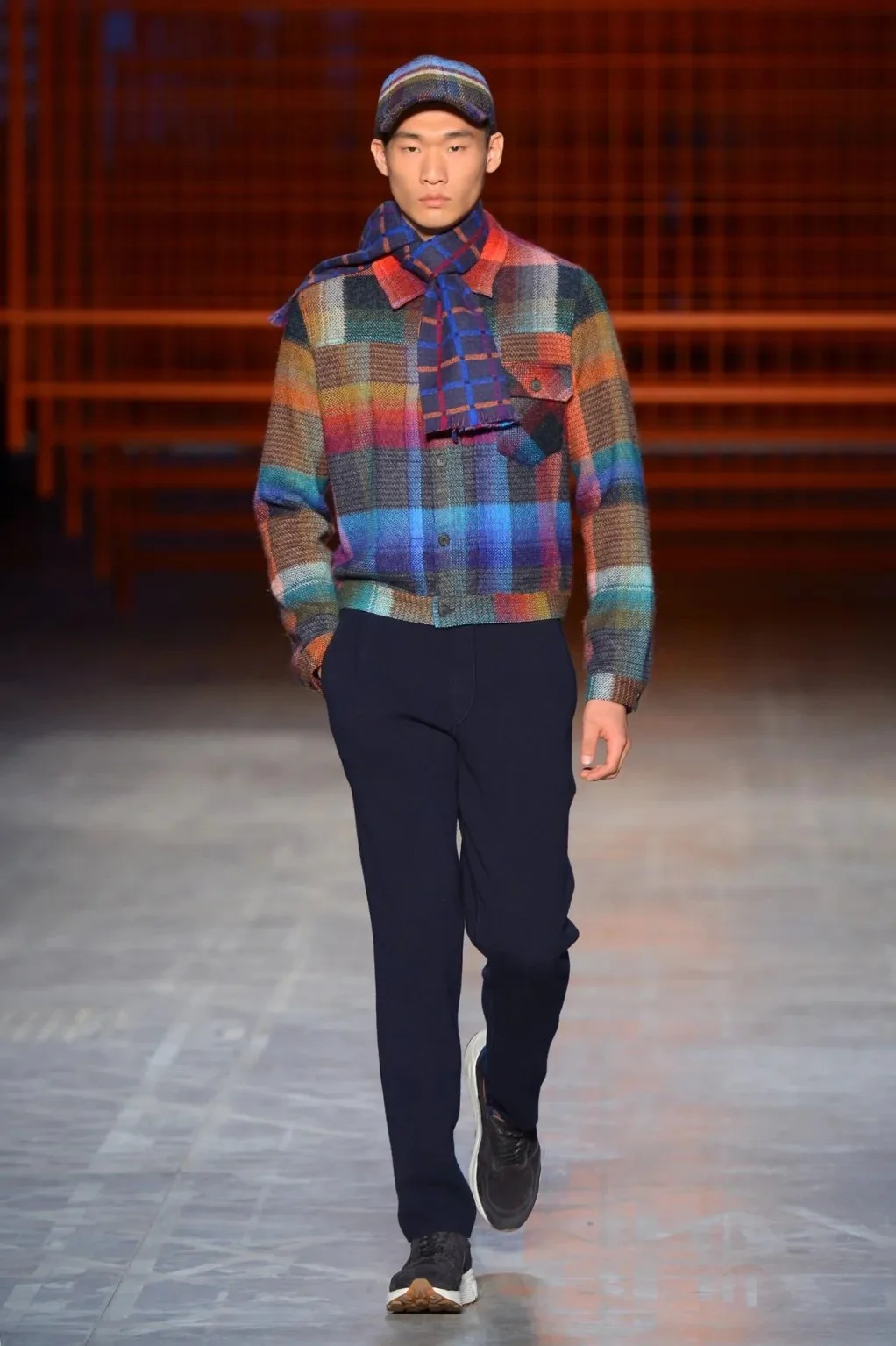
Missoni Fall/Winter 2017
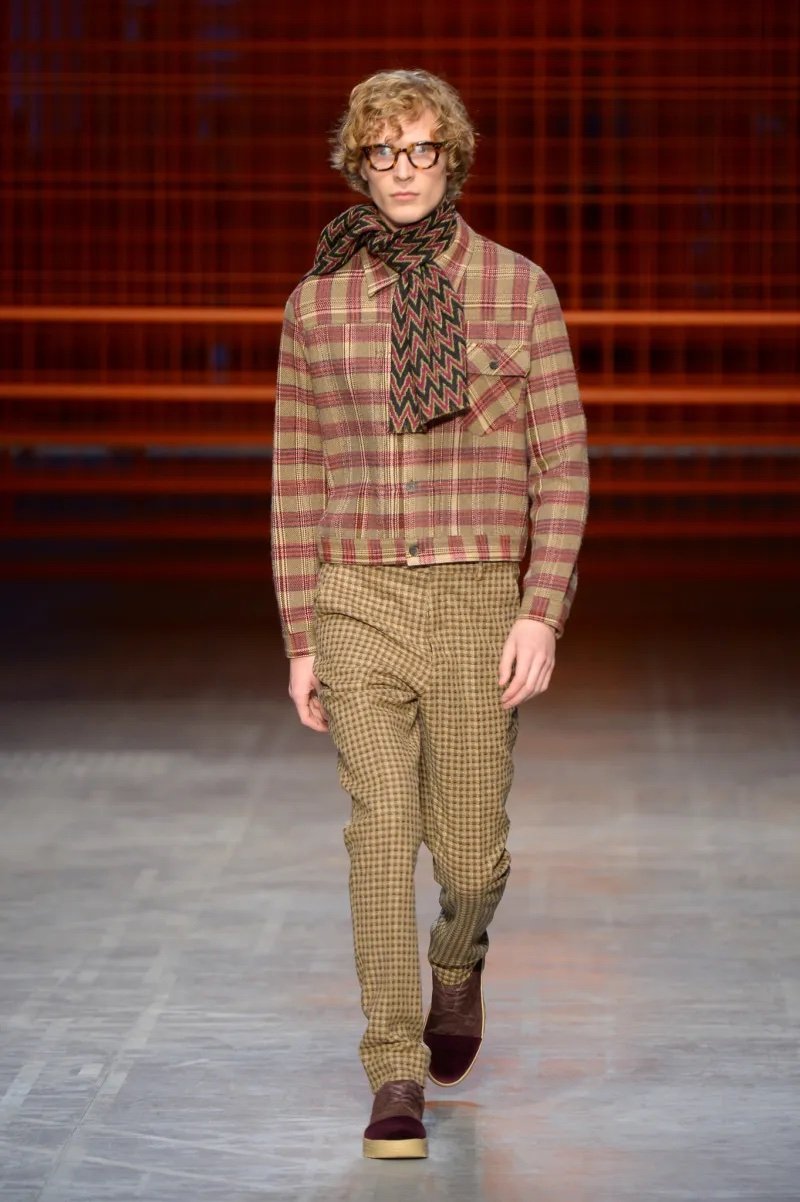
Missoni Fall/Winter 2017
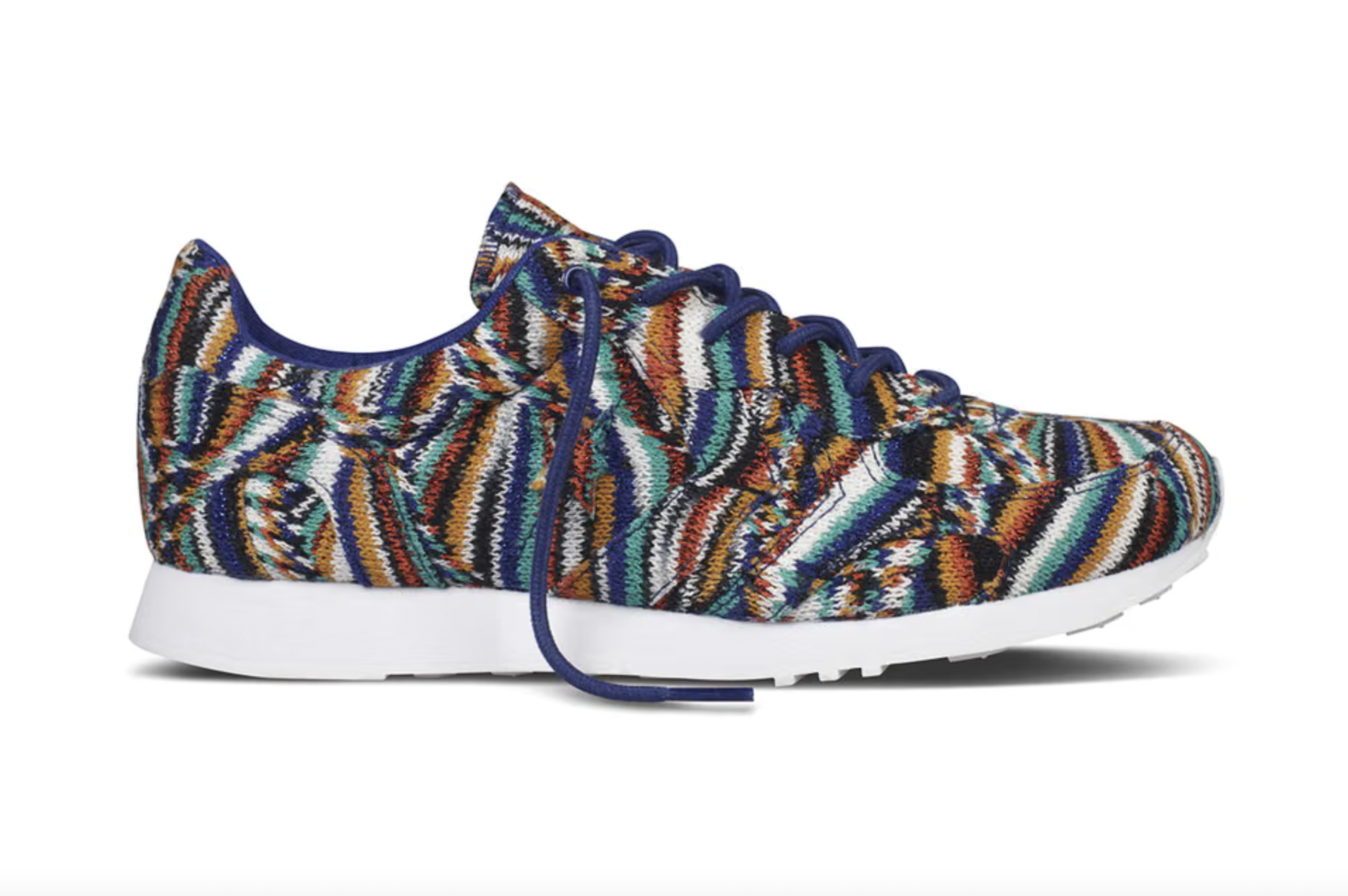
Missoni x Converse - Spring/Summer 2013
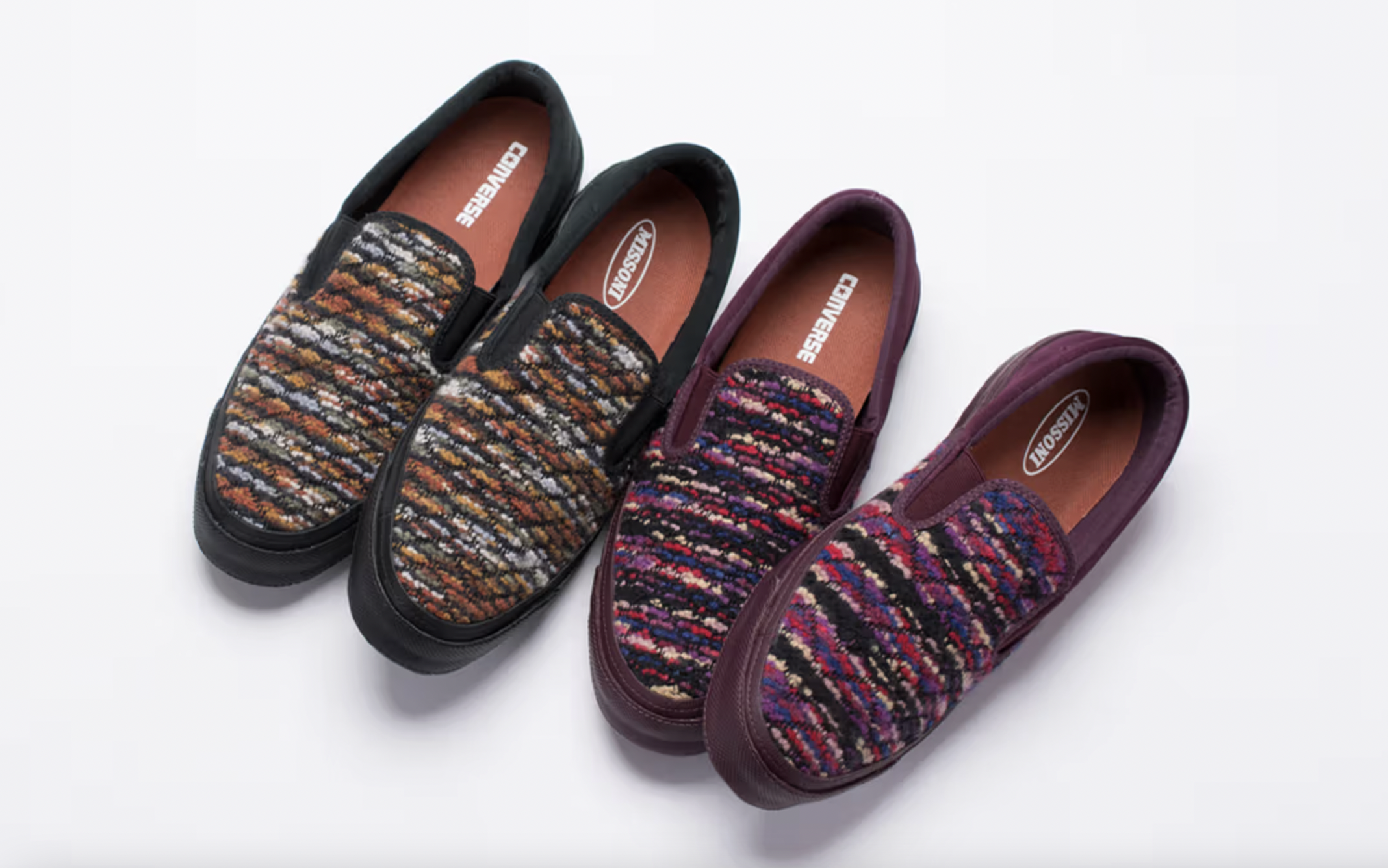
Missoni x Converse - Fall/Winter 2015
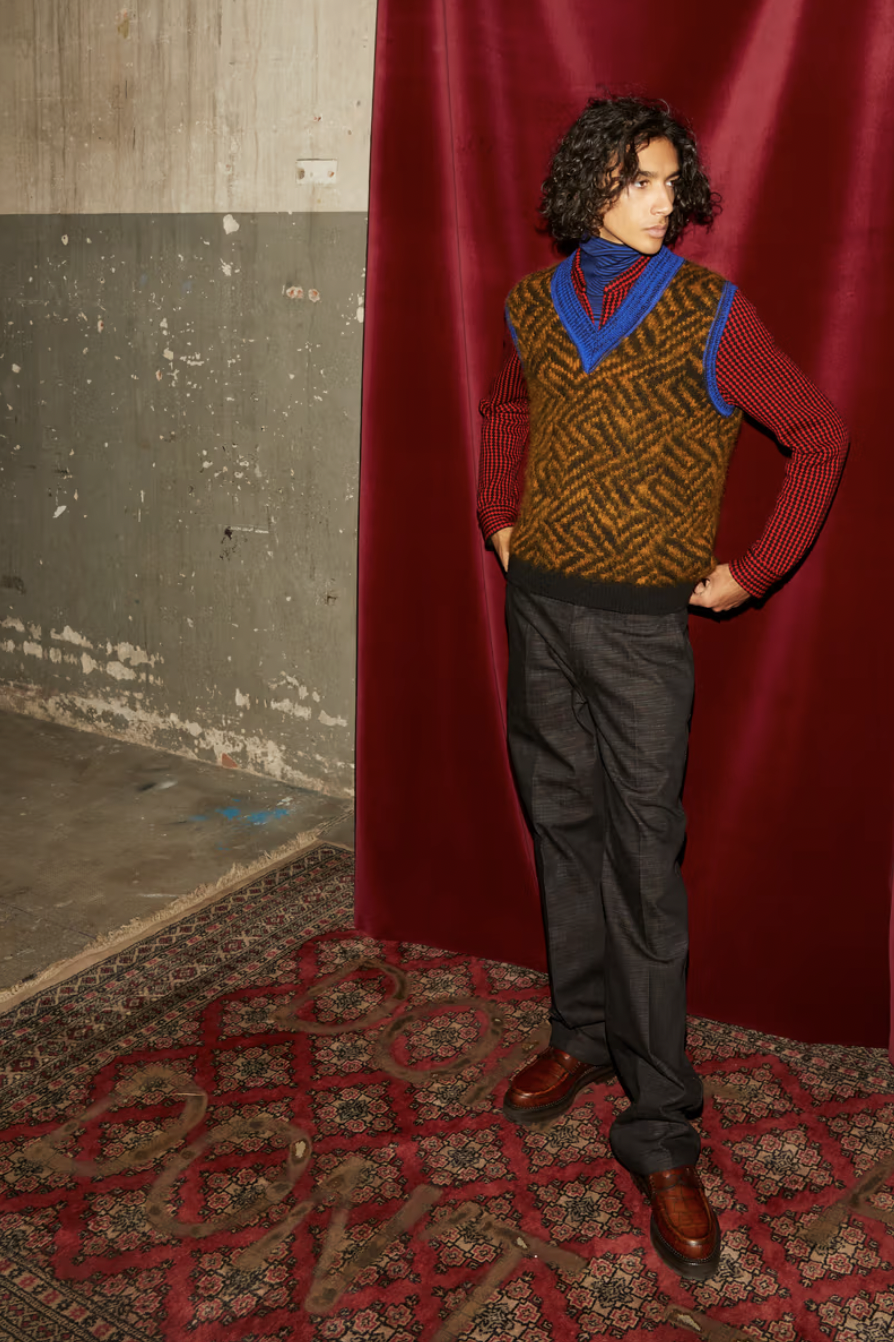
Missoni Fall/Winter 2018
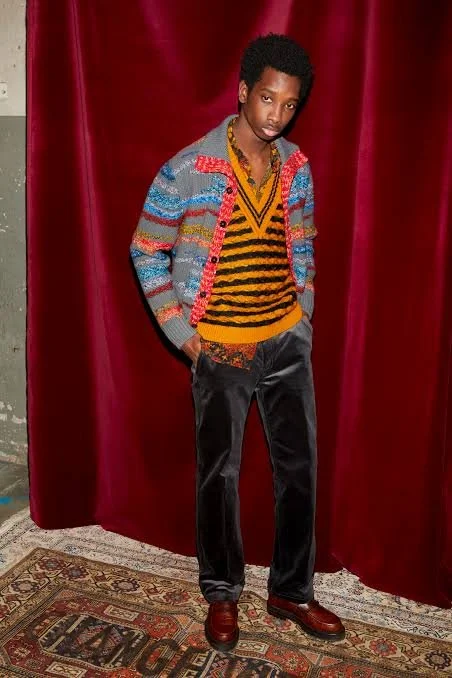
Missoni Fall/Winter 2018
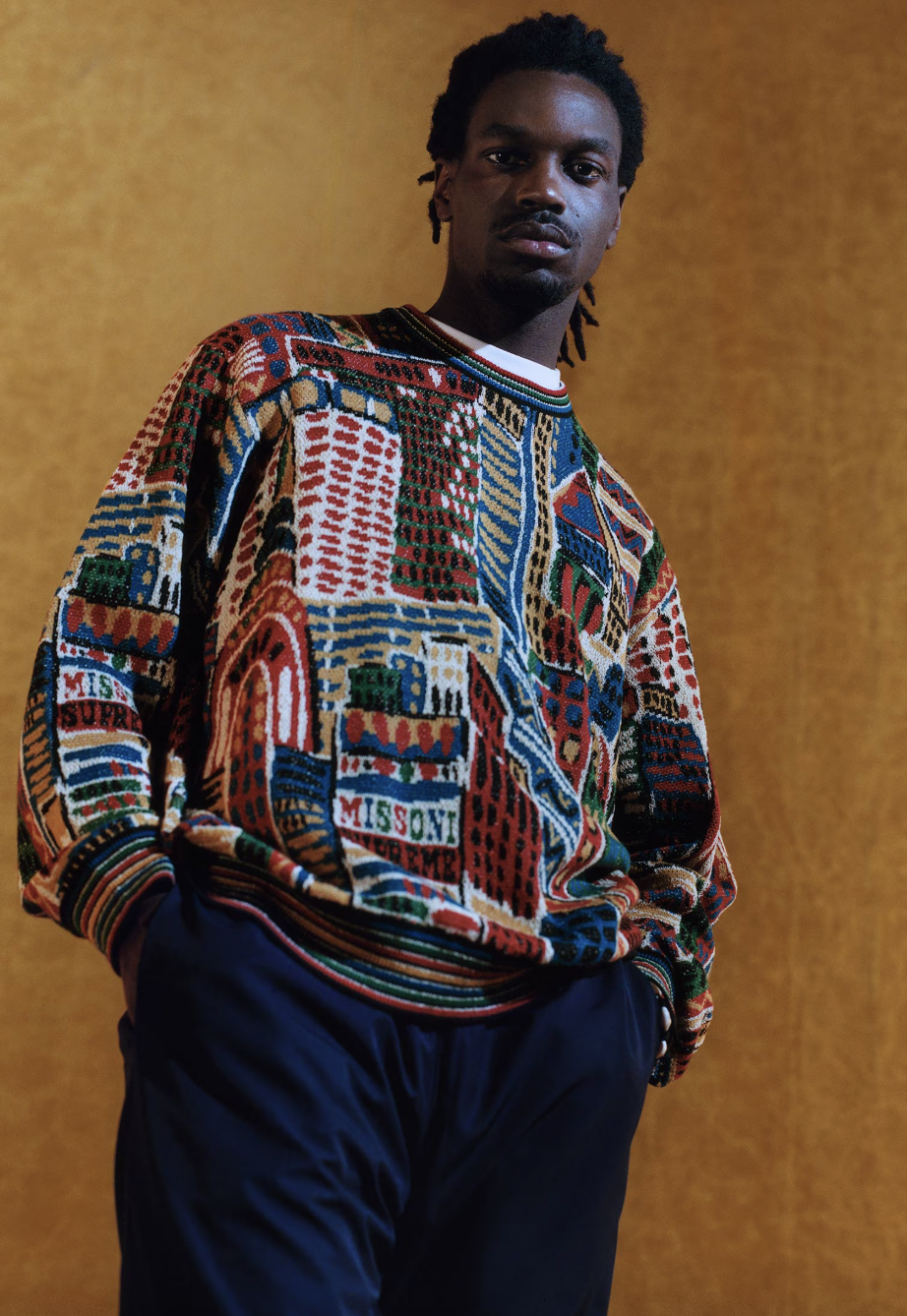
Missoni x Supreme - Fall/Winter 2021
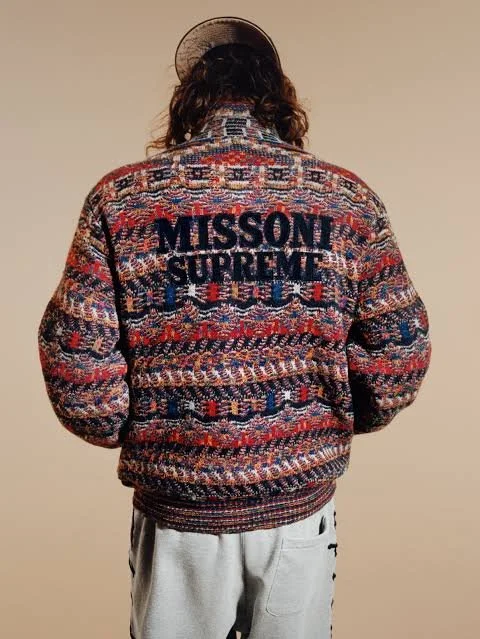
Missoni x Supreme - Fall/Winter 2021
Highlights from Mayur’s work at Missoni.
What was one of your highlights in that role?
One of the things I did was use my network to make the collection better. We collaborated with Nike, Globe-Trotter, and other companies that could bring expertise we didn't necessarily have in-house. For example, if I wanted to make a really good bag, I knew I couldn't necessarily make it myself. Missoni didn't have the specialist knowledge or the factories for every type of product. So we'd collaborate with Porter in Japan, which makes bags.
Milan is a relatively small industry. During Fashion Week, you meet people who work at different companies. Someone might say, "I work for Porter," and I'd say, "I'm at Missoni." If they needed something from us and we needed their expertise, we'd find a way to work together. Or someone might ask whether I know somebody at another company, and I might know a friend who works at Tod's. You make introductions and things develop from there. That's a big part of what I do. I'm always out meeting people.
You left Missoni in 2021 and landed at Palm Angels. Tell me a bit about that.
Missoni had been acquired by a fund, and the first thing they did was get rid of the family. That's often what happens with investment funds.
I was designing clothes that I wasn't happy making. I was producing navy-blue jumpers with a little Missoni-style piping, and it just wasn't for me. The opportunity at Palm Angels came along because I'd already worked with them on a collaborative project with Missoni. They got in touch and asked whether I'd be interested in helping them. I stayed at Palm Angels for three or four years.
You’re currently working with both Stone Island and Moncler as a knitwear consultant. How did that come about?
I already knew people at Stone Island and Moncler. They used to come to the Missoni shows, and we had mutual friends. They'd see my collections and we'd keep in touch. Eventually, that's how I got the opportunity.
I've always had a bit of a love affair with Stone Island. Being English, I'd been introduced to the brand at the Royal College of Art, and I'd always admired how technically focused the product was.
People often associate Stone Island with football hooligans, but the company is actually an incredible textile innovator. They'll take a fabric such as poplin and treat it with rubber or other coatings to make it waterproof or give it a completely different finish. They experiment with materials in extraordinary ways. I wanted to bring that same spirit of experimentation to their knitwear.
Looking back at your career and everything you've designed, what are some of your favorite pieces?
One of my absolute favorites is a jumper I created for Stone Island using retroreflective yarn. To the naked eye, it looks like an ordinary mélange jumper, brown flecked with white. But if you shine a flash at it, the whole thing lights up. Another interesting piece was a garment that changed color in different conditions. It looked beige, but in daylight it would turn pink.
At Missoni, I created hand-knitted and crocheted jumpers that cost around €8,000. Some were incredibly luxurious, almost like wearing a blanket. I also worked on embroidered jumpers made in India, inspired by Ladakh.
I've got lots of smaller favorites from my time at Missoni, but Stone Island is probably where I've really been able to geek out over materials. I've worked with yarns that change color in response to body temperature. You know those materials that change color when you touch them? I've experimented with those.
I've also worked with a medical-grade copper yarn. Essentially, you take a very fine copper filament and knit it into a thicker yarn. Imagine something almost as fine as a strand of spaghetti, which you then knit again using a double-stitch construction. The side against the skin is cotton, while the outside is real copper. The resulting jumper is incredibly heavy. You buy it in a copper color, but copper oxidizes over time, so the garment gradually changes color and can become almost green.
Do you think you need to live in a fashion city, like Milan or London, in order to build a career in fashion design?
I would honestly recommend living in a big city, although it doesn't have to be a fashion capital. You need to be somewhere that inspires you regularly. You want to see interesting exhibitions, go to concerts, discover good bars, and experience things that get your creative juices flowing.
I found it difficult when I first moved to Italy. I was living at the Missoni house in the countryside near Malpensa Airport, close to Varese. It was about an hour from Milan, and I struggled because there wasn't much happening. It was completely rural and the mentality felt quite provincial. Eventually, I moved to Milan and commuted every day. It took about an hour and a half each way, but I felt that being in the city made a difference to my work. I'd go to exhibitions, see concerts, and bring those experiences back to the office.
What were your experiences like at Ravensbourne University and the Royal College of Art?
Before Ravensbourne, I did a two-year BTEC foundation course in fashion design. Then I studied fashion design at Ravensbourne for three years. In my final year, I specialized in menswear, and for six months I focused specifically on knitwear. I completed my graduate collection, which led to an opportunity to study at the Royal College of Art, where I did my master's in menswear knitwear.
Why did you choose menswear as your focus?
I always wanted to make clothes that I would actually want to wear. Knitwear, in particular, intrigued me because it's such a tactile product. You knit something, wait for it to come out of the machine, and then see what you've created. You can felt it, embroider it, and experiment with it in so many different ways. If you boil knitwear, for example, you can create your own textile and make something almost as stiff as a conventional fabric. I was fascinated by how knitwear worked and by all the possibilities it offered.
There also weren't that many people doing it, which made me want to explore it further. Knitwear is incredibly versatile. Think about it: Until around 2012, who would have imagined that you could make knitted shoes? Then Nike came out with its Flyknit technology.
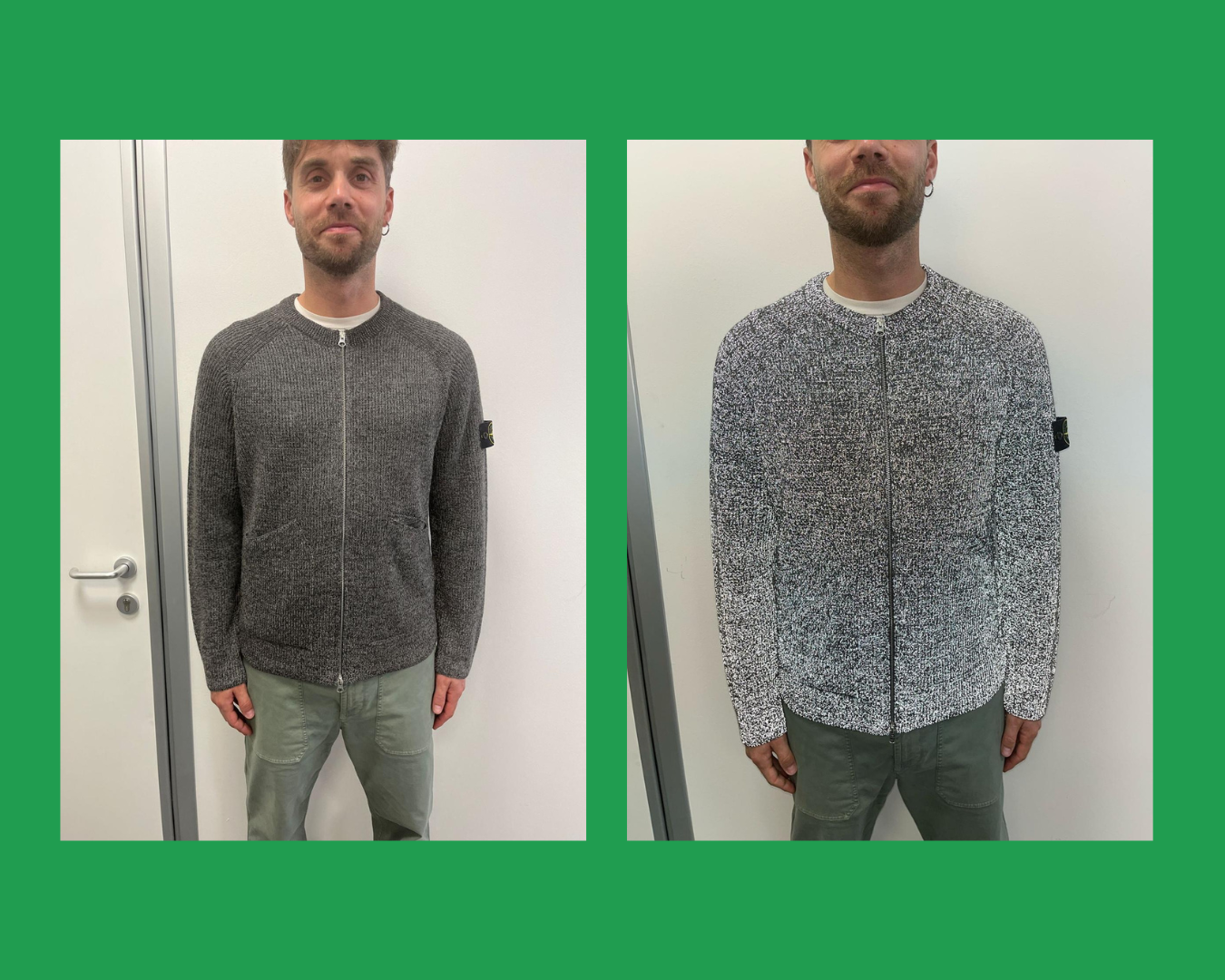
Stone Island. Left: Retroreflective yarn with linen and wool to the naked eye. Right: With flash.
Can you explain knitwear for people who don't understand what it means in fashion design? When people hear the word, they might just think of hand-knitted sweaters. What exactly is knitwear?
Knitwear is about using yarn to create a textile on knitting machines. You can make anything from seamless tubular knits to fully fashioned and engineered knits. You can produce incredibly fine knits, including jersey, or create something much chunkier. What's amazing about knitwear is that you're creating garments or products that take shape while offering comfort. The material isn't rigid; it's pliable and flexible.
Of course, there's the kind of chunky hand-knitting your grandmother might do, but that's just one end of the spectrum. Machine knitwear is produced in different gauges. Eighteen gauge is one of the finest, commonly used gauges, followed by 14, 12, 7, 5, 3, and 1.5 gauge. At one-and-a-half gauge, you're looking at some of the chunkiest machine-knitting available. The gauge essentially determines the size of the stitches.
The finer the knit, the more expensive it generally is because it takes longer to produce. Imagine buying an 18-gauge cashmere jumper. Cashmere is already expensive, and then you have to account for the time it takes to knit the panels. It can take several hours to make a single jumper.
One of the great things about knitwear is that you can construct the garment directly on the machine. With fully fashioned knitting, the pieces are made in their intended shapes, so there's little or no material waste. With conventional fabric, you lay the cloth out, position your pattern pieces, cut around them, and are left with the excess fabric. With knitwear, the pieces can come straight off the machine in the shapes you need.
Would you say knitwear is more sustainable because there's less waste from the manufacturing process?
Yes, it can be much more sustainable than making woven garments, particularly when you're using fully fashioned techniques that minimize waste.
How did your experiences at Ravensbourne University and the Royal College of Art prepare you for a career in fashion design?
Fashion schools have become much more technical and specialized, including in knitwear, which is great. I was fortunate at the Royal College of Art because, although I'd studied knitwear for only six months at Ravensbourne, the Royal gave me a much stronger technical foundation.
They accepted me partly because they liked my use of color and thought I had an interesting, slightly unconventional portfolio. But, technically, I was still quite inexperienced. At Ravensbourne, I'd mainly worked with domestic knitting machines. At the Royal, everyone started at the same level. We went through technical trials in which we learned to knit swatches using different stitches and techniques. Once you understood the fundamentals, you could take them further in your own projects.
After graduating, I went to Burberry, where I continued learning on the job. They would send me to factories, and I'd develop my technical knowledge through that experience.
Then I went to Missoni, where around 95 percent of the business was knitwear. That place was a school in itself. They had machines I'd never seen before. I was like a child in a sweet shop. I had so much fun. It was an incredible experience.
Mayur, thanks for sitting down with Careers in Fashion and sharing your experience with everyone!
Photo credits: All photos and video courtesy of Mayur Ghadialy, unless otherwise specified.